The Lake Champlain–Lake George Regional Planning Board is updating the region’s Comprehensive Economic Development Strategy. This five-year strategy helps guide economic development priorities, identify regional challenges and opportunities, and support future investment across Clinton, Essex, Hamilton, Warren, and Washington Counties.
The CEDS is an important regional planning document that helps communities, businesses, organizations, and local governments work together toward a stronger, more resilient regional economy.
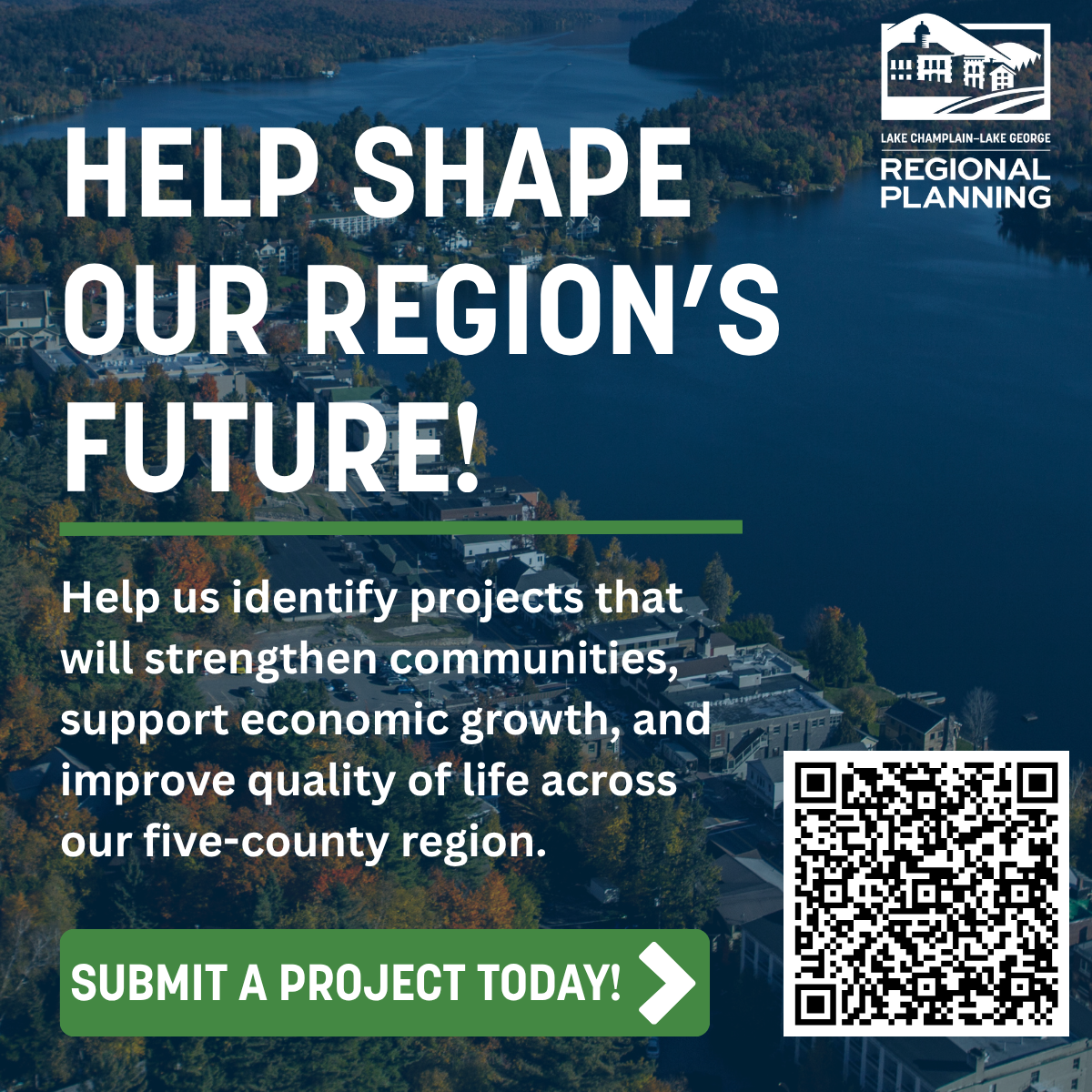
Planning a project that could move our region forward? Whether you are pursuing infrastructure improvements, business expansion, housing development, community facility upgrades, recreational enhancements, or another idea that could strengthen the region, we want to hear from you!
Municipalities, businesses, nonprofits, economic development organizations, and community partners are invited to submit projects for consideration in the region’s 2027–2031 Comprehensive Economic Development Strategy (CEDS).
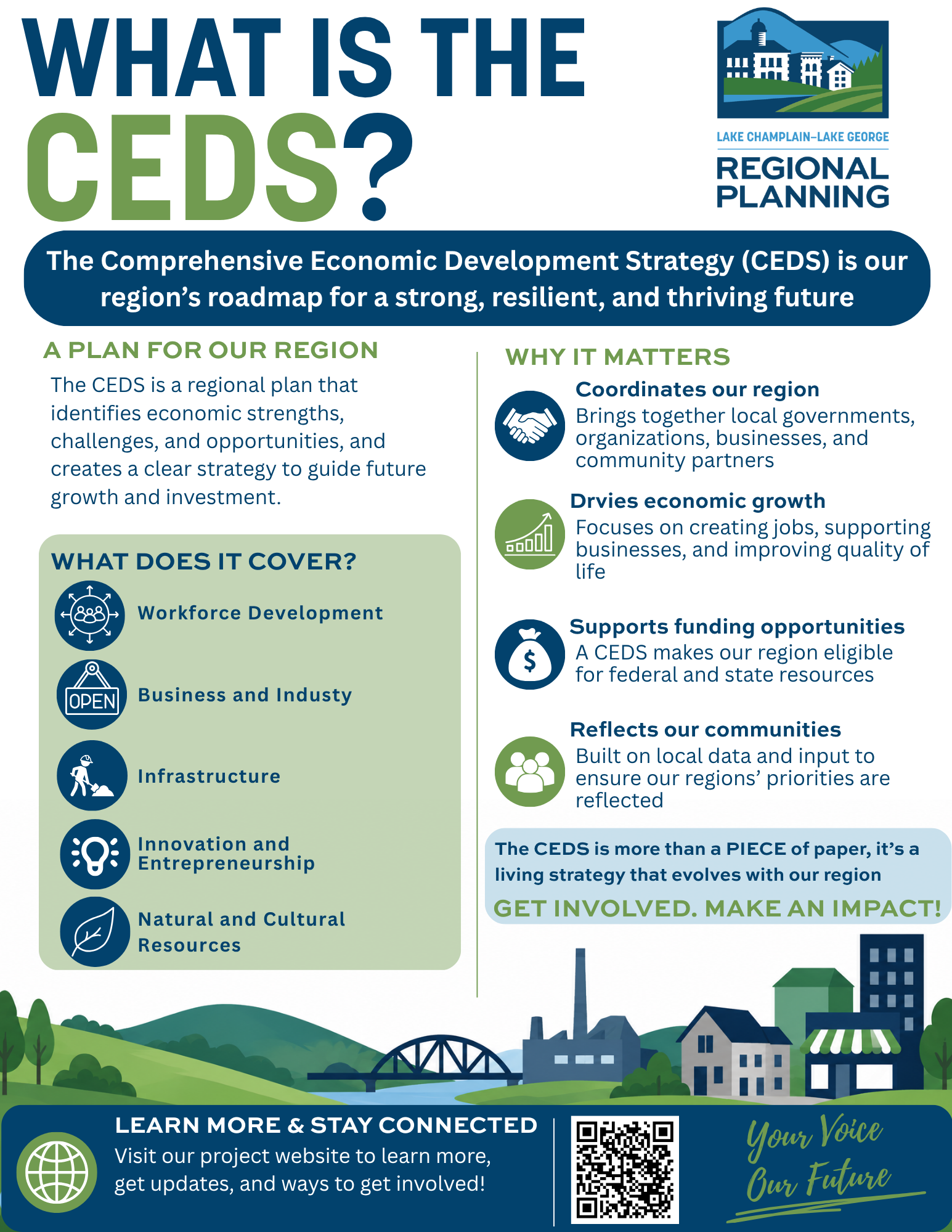
A Comprehensive Economic Development Strategy, or CEDS, is a five-year regional strategy that helps guide economic development priorities, investments, and decision-making.
The CEDS provides a snapshot of current economic conditions, identifies regional strengths and challenges, and outlines goals and strategies to support long-term economic growth and resilience.
For the Lake Champlain–Lake George region, the CEDS helps communities, businesses, nonprofits, and local governments across Clinton, Essex, Hamilton, Warren, and Washington Counties work together toward shared priorities. It also helps position the region for state and federal funding opportunities, including programs administered by the U.S. Economic Development Administration (EDA).
The CEDS helps guide decisions related to:
The CEDS is made up of four parts:
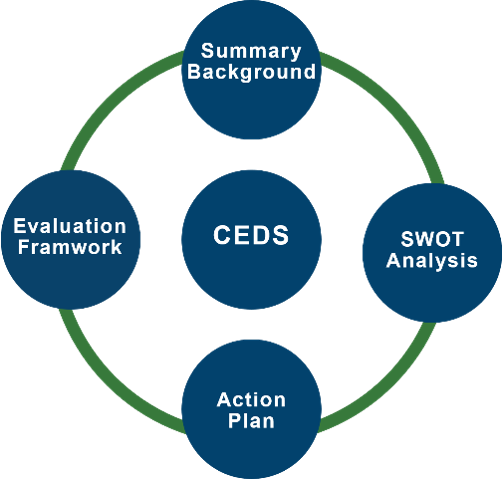
Summary Background
Describes where the region is now, highlights existing conditions, and summarizes recent economic development efforts.
SWOT Analysis
Identifies the region’s strengths, weaknesses, opportunities, and threats to better understand the factors shaping its economic outlook.
Action Plan
Establishes the regional vision, goals, strategies, and priority actions needed to support economic growth and resilience.
Evaluation Framework
Outlines how progress will be measured and how the region can track implementation over time.
The plan also supports regional eligibility for federal economic development funding programs through the U.S. Economic Development Administration.
Our region continues to face both opportunities and challenges, including workforce shortages, housing constraints, infrastructure needs, changing tourism patterns, and evolving business conditions. The CEDS update provides an opportunity to better understand these issues and develop strategies that reflect local and regional needs.
The CEDS update will take place over the course of 2026 and will include multiple opportunities for public and stakeholder input.
Receive news and stay updated with economic growth in the North Country

Lake Champlain - Lake George Regional Planning Board
P.O. Box 765
1 Lower Amherst Street
Lake George, NY 12845
Phone: (518) 668-5773
Fax: (518) 668-5774


© 2018-2020 All Rights Reserved

